EFDC+ Explorer
A Pre- & Post-Processor for the Environmental Fluid Dynamics Code
Grid Initialization
EFDC+ Explorer (EE) offers multiple pathways for model grid setup — generating a new Cartesian grid from scratch, building with Grid+, or importing an existing grid from a third-party tool or another hydrodynamic modeling system. This flexibility lets you move quickly from domain definition to a working EFDC+ model, whatever your starting point.
Grid+ Import
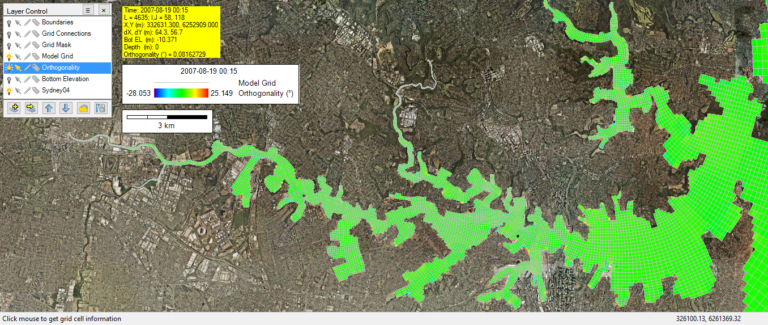
Grid+ Import
Grid+ is EEMS’s curvilinear orthogonal grid generation tool and the successor to CVLGrid. Purpose-built for EFDC+, it is equally compatible with any 2D modeling tool that uses curvilinear grids. EE is optimized to import Grid+ files and convert them into a fully configured EFDC+ model with minimal setup effort.
Generation & Import Options
Cartesian Grid Generation
EE generates Cartesian grids with either uniform or variable grid spacing. A simple rectangular domain requires only a defined extent and grid interval; more complex geometries can be specified using a shoreline file. These tools are particularly useful in early model development, where rapid iteration on grid resolution is often needed.
Third-Party Curvilinear Grid Import
EE imports curvilinear grids from a range of third-party utilities, including Delft RGFGrid (GRD files), Grid95, and SEAGrid, as well as generic cell-based nodal coordinate files. Existing grid work carries directly into EFDC+ without rebuilding from scratch, preserving time already invested in domain definition and grid refinement.
Other Model Grid Import
EE supports direct grid import from several hydrodynamic models, including CH3D-WES, CH3D-IMS, ECOMSED, and prior versions of EFDC. Multi-subdomain grids are fully supported, including disconnected subdomains that can be linked using EFDC+'s north/south and east/west cell connection features.