Watershed Planning
Challenges with Watershed Planning
Environmental regulations require the development and implementation of watershed plans to meet water quality standards and protect water resources. Engineers and regulators working with impaired or threatened waters must undertake watershed planning that considers all stages in the land development process from land use planning through to land development and post occupancy.
Solutions Provided by EEMS
EFDC+ is often used in watershed and hydrodynamic modeling to determine the impact of land use change and impacts on the aquatic ecosystem. EFDC+ is frequently coupled with watershed modeling packages such as LSPC or HSPF for modeling land use scenarios. EEMS generates data and sophisticated visualizations on changes in temperature, salinity, sediment concentration and water quality. This assists program managers with the best available, most economic means of reducing nonpoint source pollution. See our blog post on how to link HSPF with EFDC+ here.
Example Studies
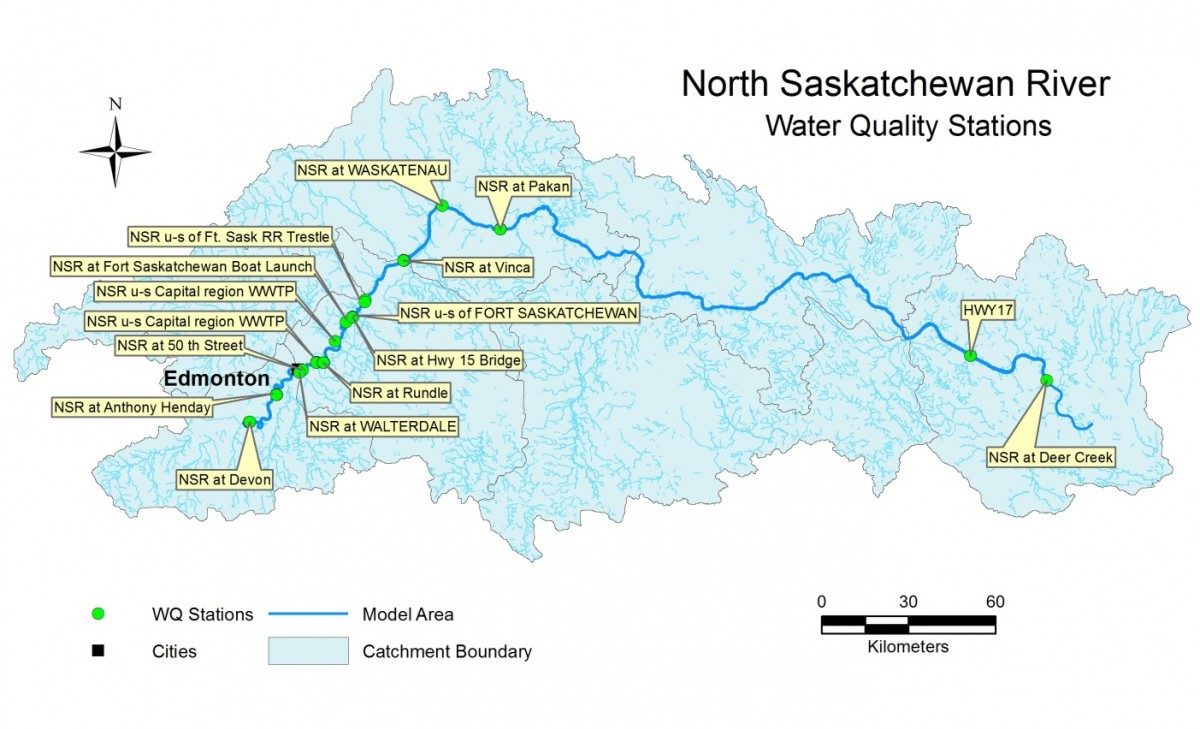
North Saskatchewan River WQ Modeling Report, Canada
EEMS was used to provide calibration support to Alberta Environment and Sustainable Resource Development (ESRD) for the North Saskatchewan River (NSR) water quality model. Modeling included Longitudinal and Lateral Mixing (Incorporating new Dye Study data), Total Suspended Solids Calibration, Macrophyte Calibration, Epilithic Algae Calibration, Temperature Calibration, Water Quality Calibration, Dissolved Oxygen Calibration, Bacteria Calibration.
Little Bow River WQ Modeling Report, Canada
EEMS was used to provide calibration support to Alberta Environment and Parks for the Little Bow River. The calibrated model was used to simulate the scenarios for water management in the Little Bow River. Scenarios simulated included supporting Highwood Diversion Plan flow management, reservoir operation management, and WWTP effluent water quality improvement. The model can be used as a tool for analysis of future development of the water body.