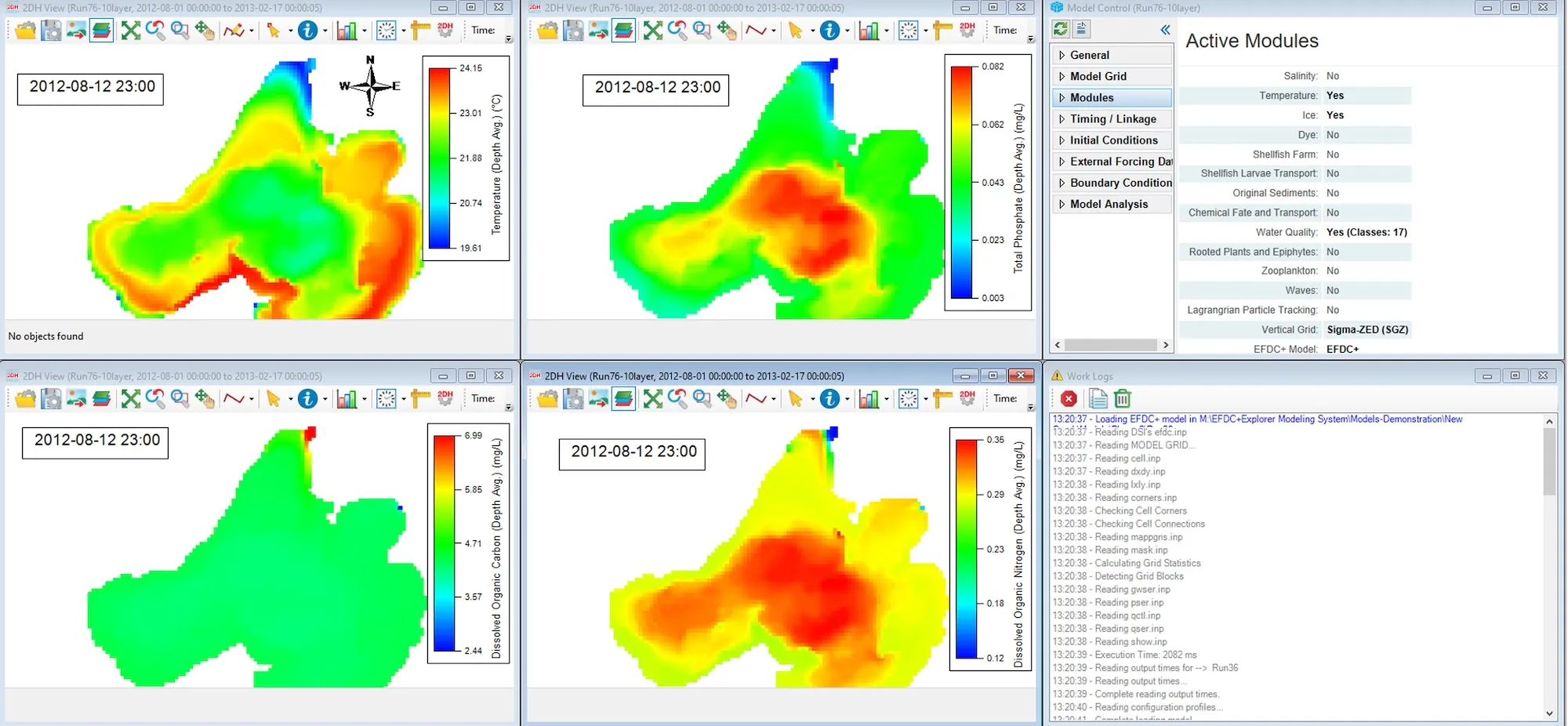
Hydrodynamics — 1D/2D/3D, variable-density, free-surface flow with temperature and salinity transport, internal and externally-linked wind-wave forcing, and standard hydraulic-structure equations for bridges, culverts, weirs, and gates.
The engine behind the EFDC+ Explorer Modeling System
EFDC+
The open-source hydrodynamic engine built on 25+ years of validated science
A single coupled model for hydrodynamics, sediment transport, chemical fate and transport, and eutrophication — descended from the EPA's original Environmental Fluid Dynamics Code, continuously developed by DSI since 1998, and benchmarked at up to 25x faster on modern multi-core and HPC systems.
25+ years of continuous development
100s of published applications to rivers, lakes, estuaries & coastal systems
Open source publicly maintained on GitHub
Up to 25x faster on HPC clusters via hybrid MPI/OMP
Validated science. Actively advanced ever since.
EFDC+ is DSI's actively developed hydrodynamic, sediment transport, and water quality modeling engine — a single coupled model for simulating aquatic systems in one, two, and three dimensions. It traces back to the Environmental Fluid Dynamics Code (EFDC), created by Dr. John M. Hamrick at the Virginia Institute of Marine Science and later adopted by the U.S. EPA, which describes the underlying code as follows:
EFDC is a state-of-the-art hydrodynamic model that can be used to simulate aquatic systems in one, two, and three dimensions. It has evolved over the past two decades to become one of the most widely used and technically defensible hydrodynamic models in the world.
— U.S. Environmental Protection Agency
DSI has continuously maintained and extended that codebase as EFDC+ — rebuilding its numerics for stability and speed, adding hybrid parallel processing, and coupling in sediment, toxics, and full eutrophication modules that used to require separate, externally linked models. That work hasn't stopped: bug fixes and improvements ship as compiled executables and as public source on GitHub on an ongoing basis, not as a one-time release — because a model your project depends on for a multi-year permit or litigation timeline needs someone actively maintaining it.
That combination is what sets EFDC+ apart: a codebase that's both openly published and actively maintained. It ships as ready-to-run compiled executables — no build step required — with full source available on GitHub, so you can read, audit, or extend the model yourself. And because DSI keeps developing it year over year, you're working with current, supported science rather than a static release from years past.
View EFDC+ on GitHub →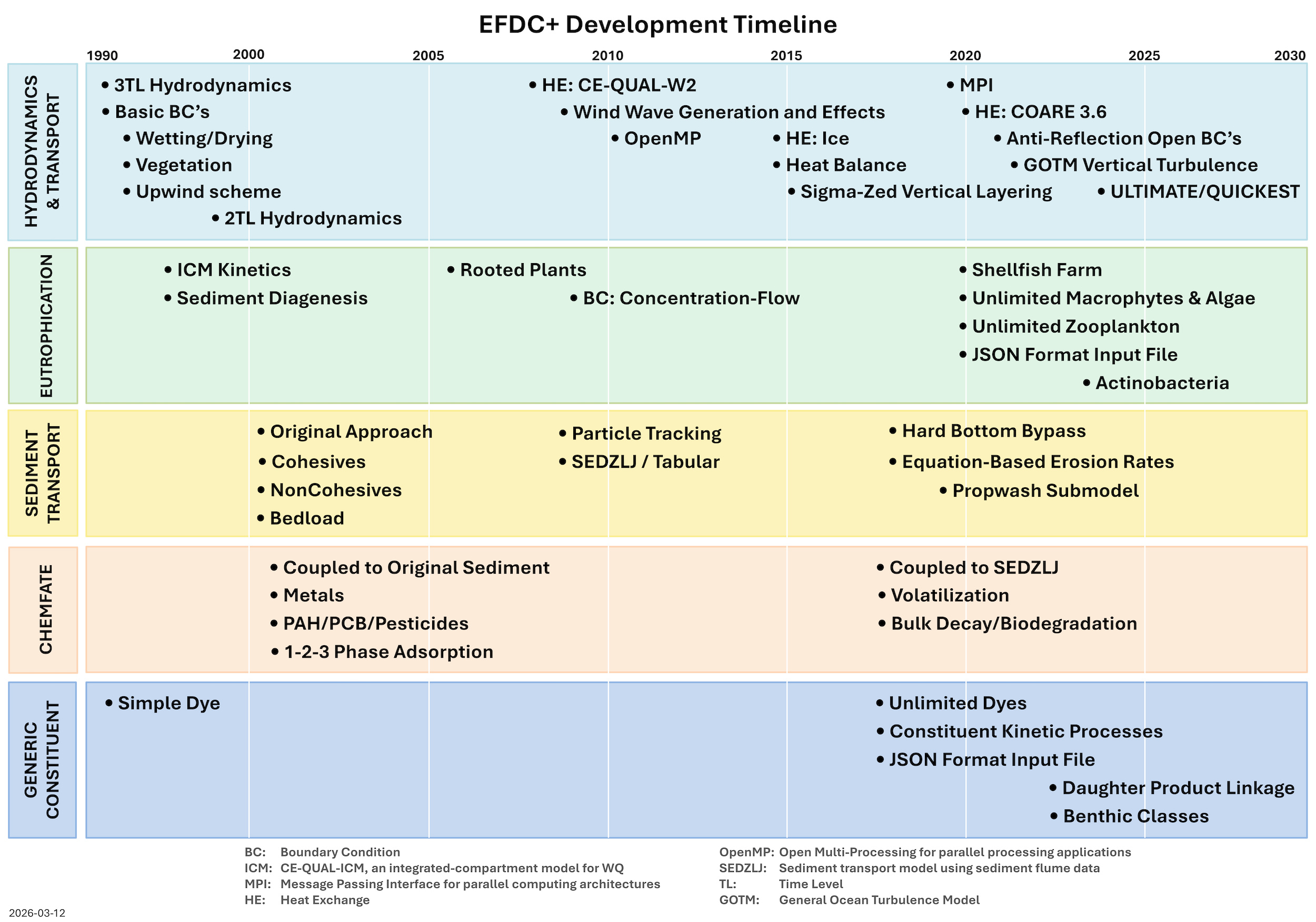
One model, not five models stitched together
Every process below runs inside the same solve — no external linkage, no file handoffs between separate hydrodynamic, sediment, and water quality codes.
Sigma-Zed vertical layering — a hybrid sigma/z-level vertical grid that keeps pressure-gradient errors low in systems with steep bed-elevation changes, where a pure sigma grid struggles. Read more →
Sediment transport — cohesive and non-cohesive classes, bed armoring, multi-layer bed history, and full morphodynamic feedback into the hydrodynamic solve. Includes SEDZLJ, Sandia National Laboratories' sediment-flume-based erosion model, extended by DSI to cover toxics and multi-threaded for faster runtimes.
Chemical fate and transport — toxics and contaminant transport coupled directly to the sediment bed model, for sites where contaminated sediment is the actual regulatory question.
Eutrophication and water quality — a full water-quality module with unlimited phytoplankton and zooplankton groups, a sediment diagenesis sub-model (built on the DiToro Chesapeake Bay Model formulation, 27 state variables), and a Rooted Plant and Epiphyte Module for submerged aquatic vegetation.
Propeller wash — ship-induced turbulence and resuspension, driven by AIS or user-defined vessel tracks — built for navigation and dredging studies where prop wash is the dominant local sediment source.
Particle tracking — Lagrangian tracking for larvae, oil, or dissolved constituents through the same computed flow field.
Built to run on what you already have — and to scale when you need it to
EFDC+ uses a hybrid MPI/OMP domain decomposition, so the same model can run efficiently on a single workstation or scale out across a cluster.
That's the difference between a calibration run that takes a weekend and one that takes a week — without moving to different software or re-building your model for a different solver.
Read the MPI/OMP performance white paper → ~4x faster on a 6-core desktop processor, vs. the original single-threaded EFDC
~17x speedup on a 500,000-cell domain using 32 compute cores
~25x speedup in an AWS cluster benchmark using 96 compute cores
An independent, feature-by-feature look
We built a 150+ feature comparison across computational engine, GUI, grid generation, model input, visualization, data export, and workflow — measured against Delft3D, MIKE 3, and vEFDC.
A few of the differences that actually change a project timeline:
- Full MPI + OpenMP support, with excellent multi-core scaling — vs. limited or unsupported parallelization in MIKE 3 and vEFDC.
- No compilation required to run the model — unlike Delft3D 4 (open source), which requires building the source before use.
- A dedicated grid tool (Grid+) included — no third-party grid software required, unlike Delft3D and vEFDC.
- Continuous active development since 1998 — the original EFDC hasn't been updated since 2007.
What the people using it say
I have found EFDC+ to be a really fantastic program. It has a really intuitive interface, a nice mesh builder, and great calibration analysis... Thank you for creating this software.
[EFDC+] has saved me a tremendous amount of modeling effort, and I'm very excited and grateful to learn that DSI is planning to make it open source and available to the public.
Built for the questions regulators, courts, and engineers actually ask
- Environmental compliance — thermal compliance, TMDL studies, watershed planning, eutrophication assessments
- Habitat analysis — salinity intrusion, water temperature, IFIM analysis, light & SAV modeling, oil spill fate
- Navigation & ports — dredging impacts, propeller wash, shoreline erosion, flow patterns
- Hydropower engineering — intake analysis, tailwater analysis, dam break and flood routing
- Climate change impacts — sea level rise, temperature change, extreme weather scenarios
- Contaminated sediment management — remedial design, feasibility studies, litigation support