EFDC+
Forcing and Boundary Conditions
What EFDC+ adds to the legacy EFDC code
Convention: [EFDC+] marks a capability not present in the legacy EPA/GVC code.
The hydrodynamic solution is only as good as the conditions applied at its boundaries including the bed, the water surface, hydraulic structures, and the open edges of the domain. This page covers the forcings EFDC+ applies at each, most of which have no equivalent in the legacy EFDC code. For the governing equations, numerics, turbulence, and vertical layering, see the Hydrodynamics page.
Bottom Friction and Vegetation
Bed stress uses a quadratic resistance formulation with the drag coefficient derived from a logarithmic near-bed profile. [EFDC+] Roughness can be specified spatially and varied through the simulation, for dredging, bedform evolution, or seasonal change.
Vegetation is a hydrodynamic obstruction rather than elevated roughness, with an explicit drag term in the momentum equations and canopy production terms in the turbulence equations. [EFDC+] Drag can vary with depth along the canopy to represent submerged, emergent, and suspended canopies including aquaculture structures, and vegetation fields can vary in space and time for seasonal growth and die-off.
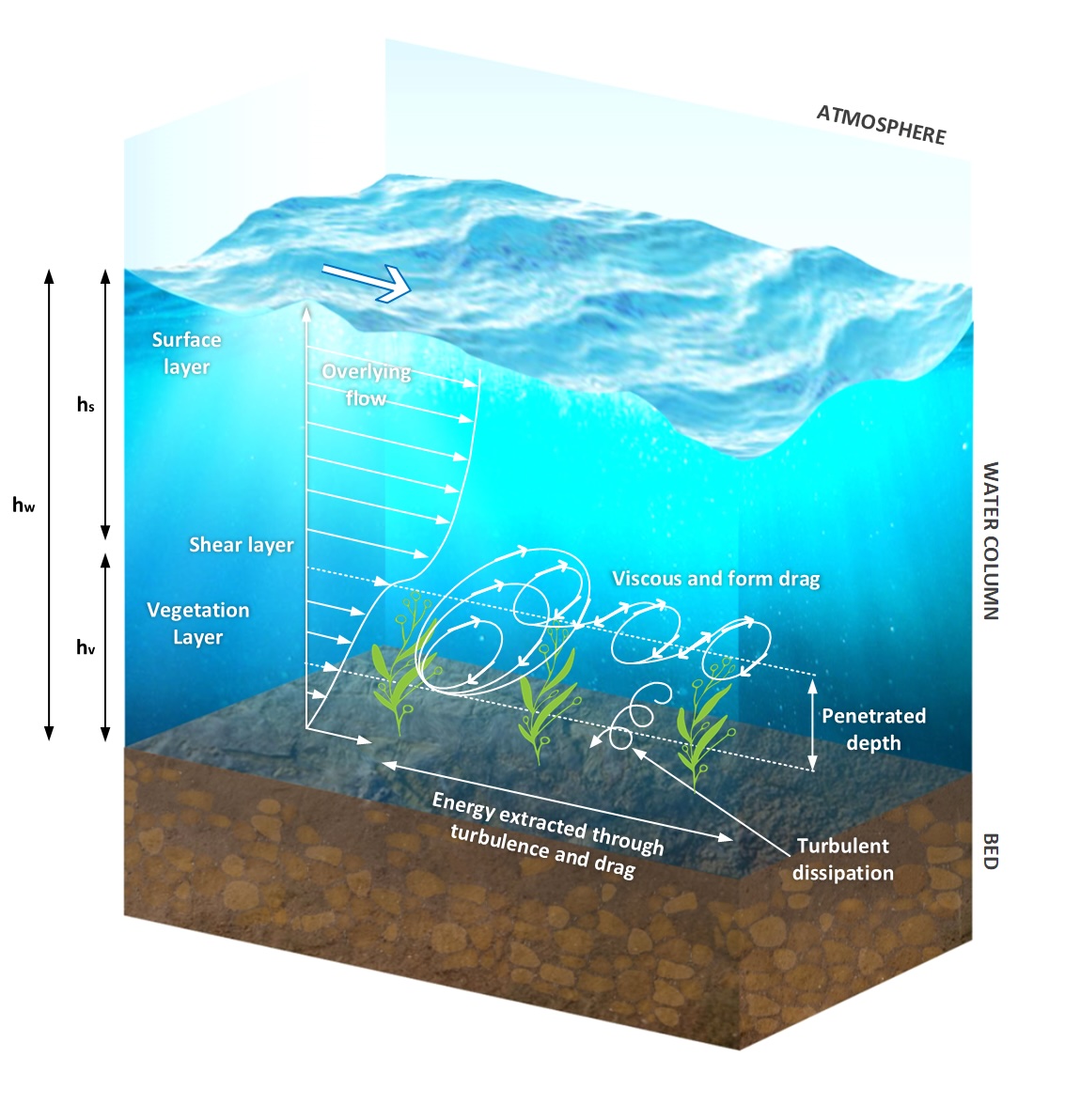
Figure 1 - Vegetation conceptual framework
Wind Forcing
[EFDC+] Where legacy EFDC offers a single wind drag relationship, EFDC+ offers five: the original relationship; the same relationship evaluated using wind speed relative to the surface water velocity; the ECMWF wave-age-dependent formulation (Hersbach, 2011); COARE 3.6 (Fairall et al., 1996, 2003; Edson et al., 2013), added in EEMS 12.1; and a user-defined linear relationship, with twelve published formulations tabulated as starting points.
[EFDC+] A tropical cyclone module generates parametric wind fields and wind pressure, and meteorological forcing can all be supplied as spatially and temporally varying fields.
Wind-Waves
[EFDC+] The legacy code has no wave capability at all. EFDC+ incorporates a wind-wave sub-model, so temporally and spatially varying wave conditions are coupled directly to the hydrodynamics, changes in water level and current appear in the wave field immediately, with no external model run.
This matters because in lakes, estuaries, and coastal systems, near-bed wave orbital velocity is frequently the largest single contributor to total bed shear stress. Longshore currents and undertow are wave-generated too.
The module uses empirical SMB formulation, computing significant wave height and peak period from wind speed, depth, and fetch, with fetch calculated from land boundaries in 16 directions. You can apply wave effects to bed shear stress alone or include the radiation stresses (Longuet-Higgins and Stewart, 1964) to model wave-generated currents.
[EFDC+] For waves arriving from distant storms, EFDC+ links efficiently to external wave models such as SWAN.
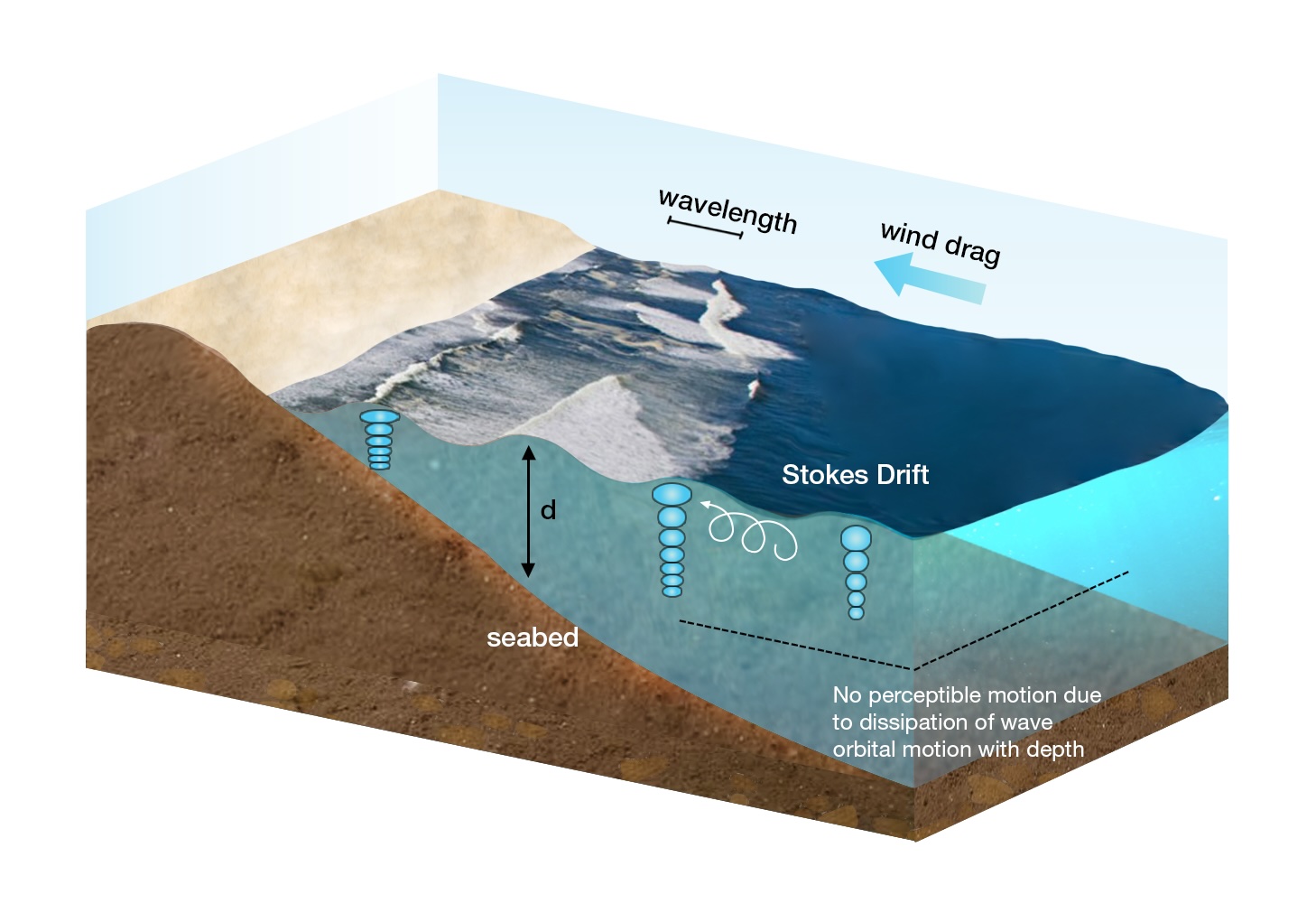
Figure 2 – Wind Generated waves conceptual framework
Hydraulic Structures
Legacy EFDC handles structures through rating curves. EFDC+ supports six rating-curve types including upstream depth, head difference, head difference with flow acceleration, upstream and downstream water surface elevations, and two low-chord variants for bridges.
[EFDC+] More significantly, EFDC+ can compute flow directly from standard hydraulic equations at every time step, so each structure responds to the evolving solution rather than a pre-computed table:
- Culverts: Regime determined from headwater, tailwater, invert, and crown elevations, with critical depth and slope checks and an adaptive normal-depth solution.
- Weirs: free flow with a discharge coefficient matched to weir type and shape, plus a Villemonte (1947) submergence adjustment.
- Sluice gates: weir, free sluice, or submerged orifice flow selected on the tailwater-to-headwater ratio, blended across the transition so discharge stays continuous.
- Orifices: weir, free jet, or submerged flow depending on headwater and tailwater.
[EFDC+] You can also define rules of operation that respond to the model hydrodynamics — opening a gate once an upstream level threshold is reached, for example. Masks block flow across cell faces for breakwaters and causeways, defined by a draft depth at the surface and a bottom sill height at the bed.
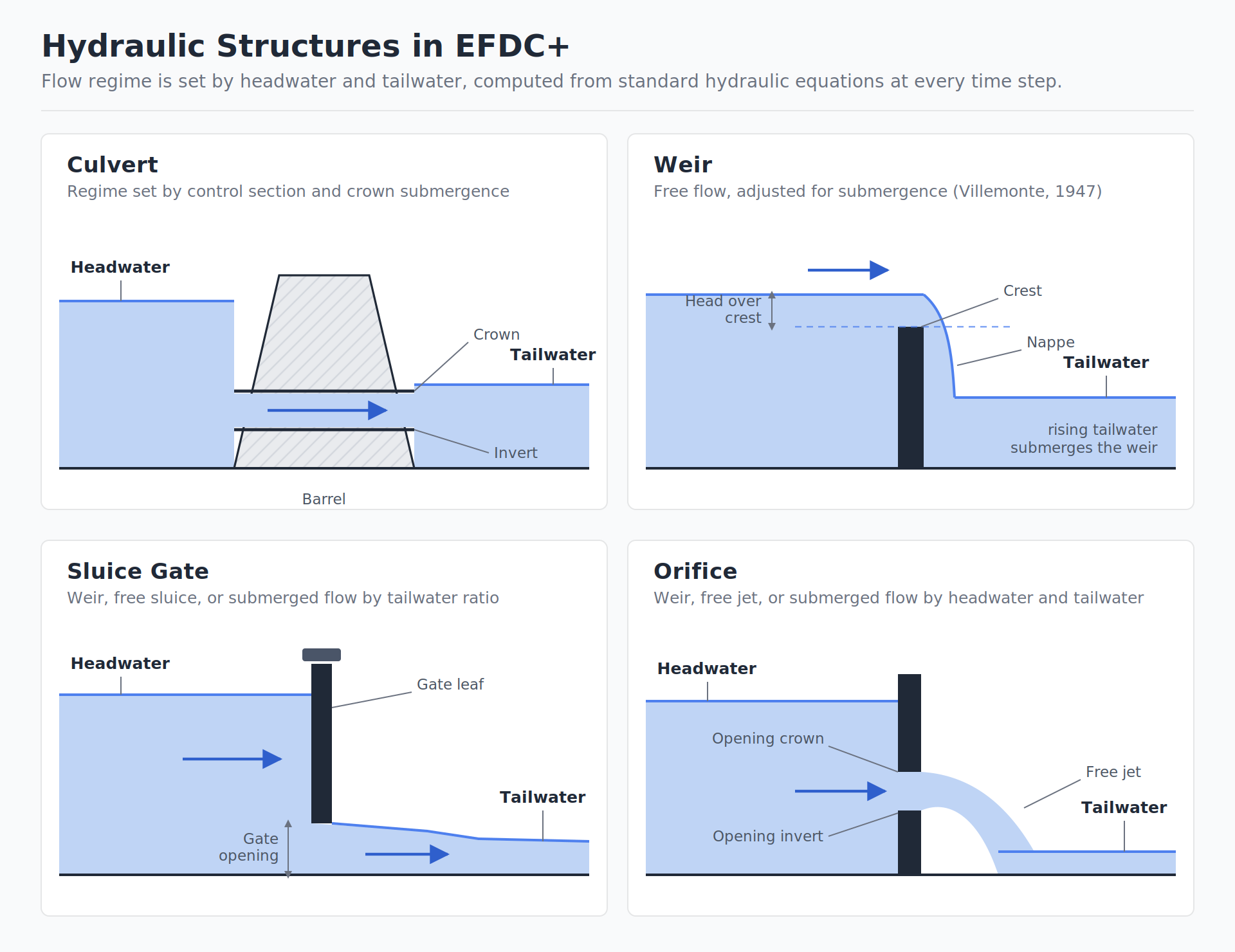
Figure 3 - EFDC+ hydraulic structures
Tidal and Open Boundary Forcing
Open boundaries accept water level time series or harmonic constituents defined by amplitude, angular speed, and phase lag.
[EFDC+] Two anti-reflection boundary types, free tangential and zero tangential radiation boundaries, let waves propagate out of the domain without reflecting back in, and harmonic forcing on these boundaries correctly handles non-zero mean tidal levels. Boundary conditions can also be supplied as spatially and temporally varying fields, simplifying nesting within larger-scale models.
Near-Field Discharge and Mixing Zone Analysis
EFDC+ includes an integrated jet/plume sub-model based on Lee and Cheung (1990), following the discharge as plume elements that rise, bend over in the current, and entrain surrounding water, through shear entrainment near the discharge point and forced entrainment from the cross flow elsewhere.
[EFDC+] DSI has recently extended the module to resolve plume behavior on a local scale, at grid resolutions of a few meters rather than tens or hundreds and validated the results against CORMIX. Because the sub-model runs inside EFDC+, it uses the ambient currents and density profile the model itself computed.
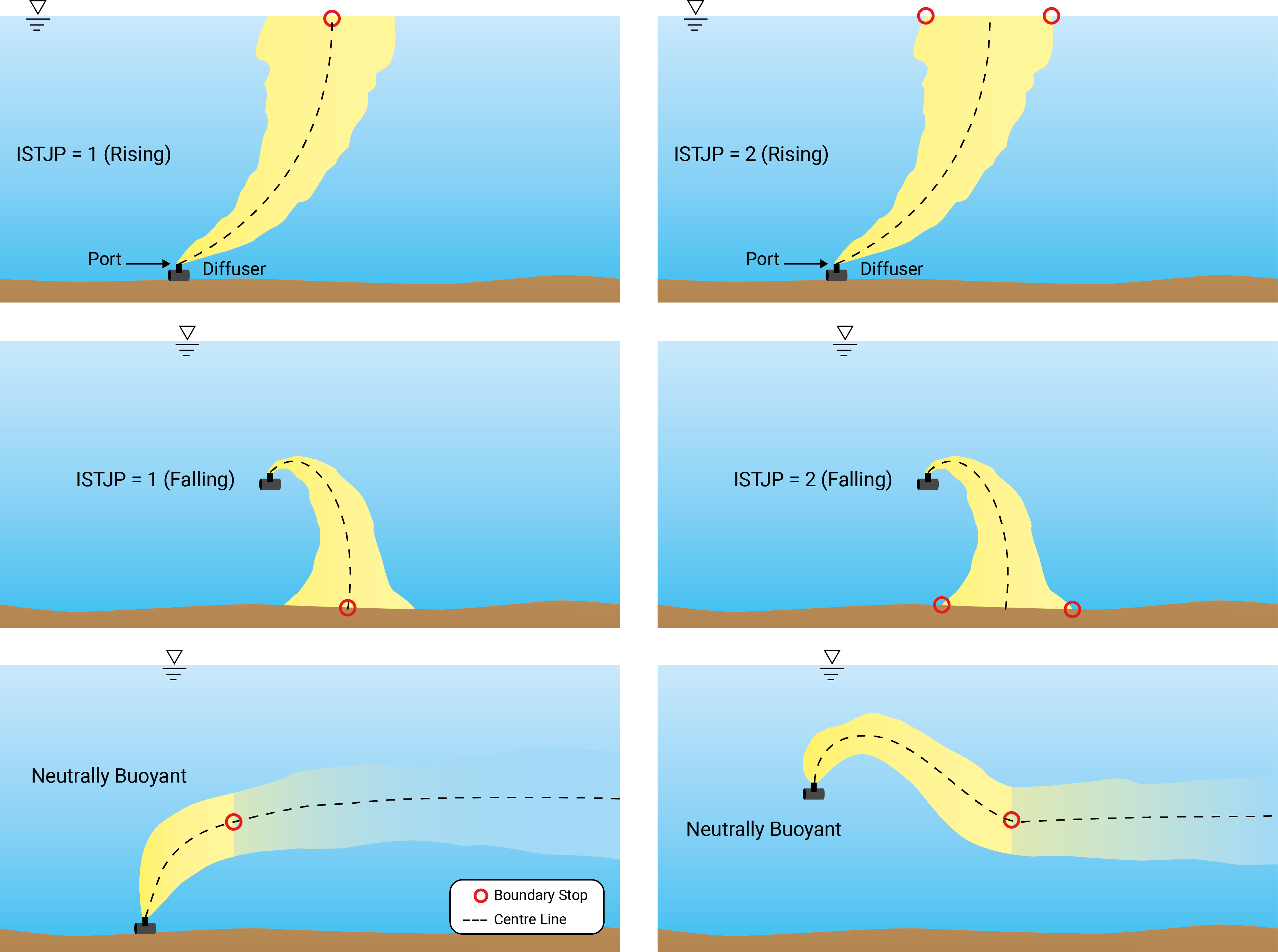
Figure 4 - Near field Jet Plume mixing
Coupling with Other Modules
[EFDC+] The hydrodynamic solution accepts momentum source terms that have no equivalent in the legacy code. The propeller wash module injects momentum from propeller efflux into the 3D flow field, distributed across the layers the propeller intersects. The marine hydrokinetics module applies momentum extraction for turbines and wave energy converters, along with the turbulence they generate and its downstream dissipation.
Results can be written to NetCDF in the UGRID standard, and EFDC+ writes a WASP8 .HYD file for external water quality simulation.