Challenges with Remedial Design
Industrial practices such as oil refineries and chemical plants commonly leave a long-term legacy of contaminated sediments. Sediment remediation is a costly and challenging undertaking. Design of remediation strategy involves methods to excavate and contain sediment hotspots, install permeable barriers, groundwater hydraulic containment systems, and isolate and cap the impacted sediments. 3D modeling of the hydrodynamics, sediment transport and specific contaminants is often required.
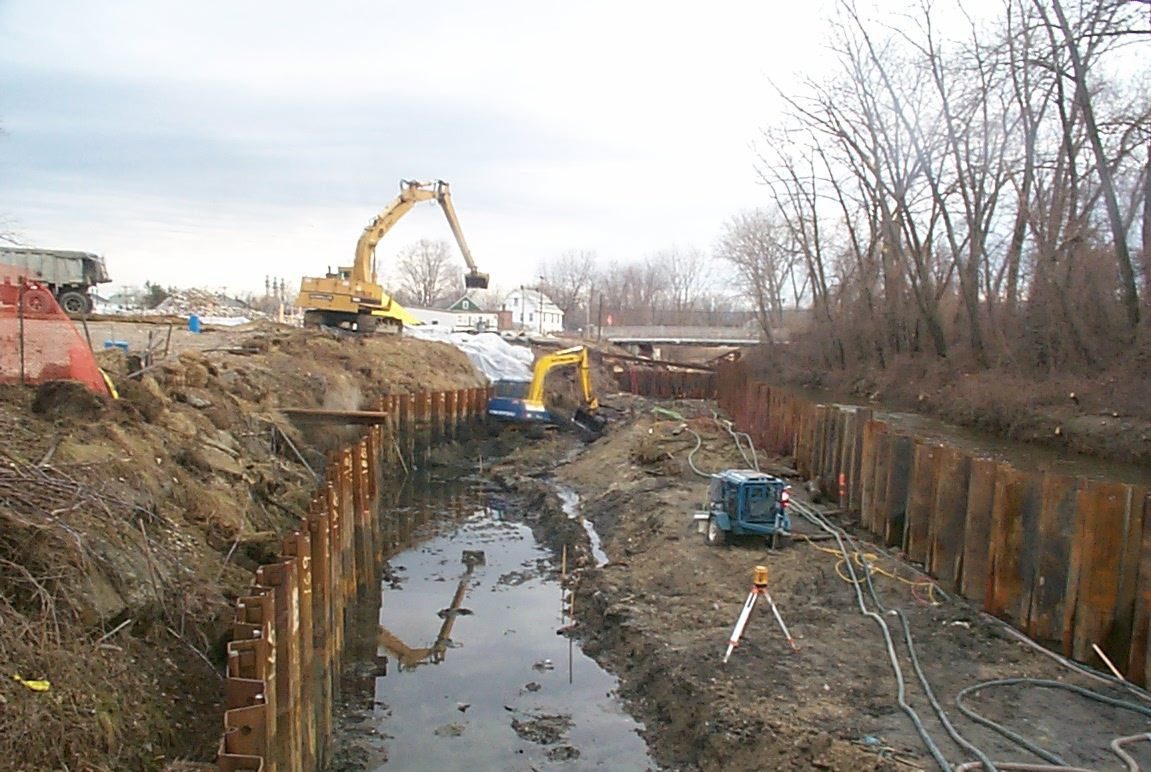
Housatonic River PCB study, MA, USA
EEMS has been used extensively in the simulation and analysis of contaminated sediment for remedial design studies. EEMS allows the user to accurately characterize the site conditions, with tools to support the data processing, model building and the simulation of the specific processes for transport of PCBs, dioxins, herbicides, and pesticides in 1-D, 2-D, and 3-D. EEMS helps in visualizing the lateral and vertical extent of toxics in the sediment bed. Comparison of scenarios for source removal actions, such as dredging, allows efficient use of resources and cost savings. Analysis of bed shear in the model domain helps determine shear stress on sediment caps.
EEMS is also used to evaluate recontamination scenarios in remedial design. The EFDC+ code includes several internal sub-models for simulating the transport and fate of toxic contaminants. A simple, single contaminant sub-model accounts for water and suspended sediment phase transport with equilibrium partitioning and a lumped first order reaction. Contaminant mass per unit area in the sediment bed is also simulated. A second, more complex, sub-model simulates the transport and fate of an arbitrary number of reacting contaminants in the water and sediment phases of both the water column and sediment bed. It includes the flexibility of simulating an arbitrary number of contaminants, and the improved accuracy of utilizing more complex three-dimensional physical transport fields in a highly accurate numerical transport scheme.
Directly models chemical constituent (PAH/metals) transport and identifies “areas of concern,” core input for both remedial design and feasibility assessment.
Directly models metals contamination (copper, lead, zinc) fate and transport, the kind of data needed to design or evaluate a remedy.
Directly models heavy metal exchange between sediment and water column, informing contamination extent and remedy design.
Dredging is one of the three named remediation techniques on the solution page (dredging, capping, in-situ treatment), making this a direct match.