EFDC+
Additional Features
What EFDC+ adds to the legacy EFDC code
Convention: [EFDC+] marks a capability not present in the legacy EPA/GVC code.
EFDC+ has been enhanced far beyond the original EPA EFDC code. In addition to the enhancements described in the other feature sections, DSI has made further improvements to meet user and project needs, including the following.
[EFDC+] Everything on this page is an EFDC+ development. None of it exists in the legacy EPA/GVC code.
Multiple Dyes and Age of Water
EFDC+ simulates an unlimited number of user-defined dye classes, and decay, growth, settling, and volatilization can be added to any of them. Dye is the simplest tool in the model and often the most useful: trace a discharge, test connectivity between two parts of a domain, or check a flow field before committing to a full water quality simulation.
Any dye class can also be configured as Age of Water, the elapsed time since a parcel of water entered the domain. Residence time and flushing rate are the quantities regulators and stakeholders tend to ask about, and Age of Water gives them directly, in days, without inferring them from a tracer decay curve.
Shellfish Farming
EFDC+ includes a shellfish farming module simulating the kinetic processes of shellfish including filtering, ingestion, assimilation, respiration, mortality, and spawning. Because it runs inside the coupled model, farmed shellfish both respond to and act on the surrounding water column: filtration draws down algae and suspended material, and the resulting changes feed back into the eutrophication solution. This supports aquaculture siting and carrying capacity assessment, alongside evaluation of shellfish as a nutrient management measure.
Marine Hydrokinetics
For the installation and operation of turbines and wave energy converters in rivers, tidal channels, ocean currents, and other waterbodies, EFDC+ fully incorporates a Marine Hydrokinetic (MHK) module to simulate their placement and potential effects. Adapted from Sandia National Laboratory’s modified EFDC code, this module has been extended to work with the Sigma-Zed vertical layering scheme.
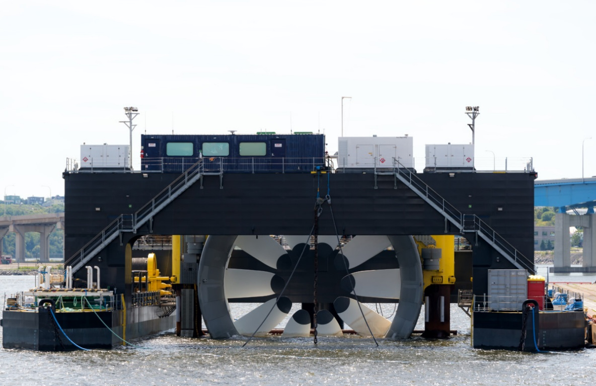
Figure 1 — A marine hydrokinetic device being moved into position. EFDC+ simulates the momentum such a device extracts, the turbulence it generates, and the power it produces.
An MHK device does more than slow the flow. EFDC+ represents three effects: momentum extraction, computed from the device’s thrust coefficient, flow-facing area, and local flow speed; the wake turbulence the device generates as it breaks up the mean flow; and the dissipation of that turbulence downstream. All three are advected and dispersed by the same conservation equations as everything else in the model.
That turbulence treatment matters for impact assessment. Early CFD studies of MHK devices produced wakes that persisted unrealistically far downstream, in part because turbulence generation and dissipation weren’t accounted for. Representing them lets EFDC+ resolve wake recovery within a realistic distance, which is what determines whether an array’s devices interfere with each other and how far downstream ecological effects extend. Device power output is computed as well, so energy yield and environmental effect come out of the same simulation.
Spatially and Temporally Varying Fields
Pressure fields, bathymetry, roughness, and vegetation can all be adjusted dynamically during a run. This is what makes dredging scenarios and seasonal vegetation patterns possible within a single simulation rather than a series of separate ones. Boundary conditions can likewise be supplied as spatially and temporally varying fields, simplifying connection to external data sources or to larger-scale numerical models.
Connection of Sub-domains
EFDC+ can use grids with two or more disconnected sub-domains in IJ space, connecting them along the E-W faces of cells as well as the N-S faces. This enables intricate grid configurations to address the requirements of complex physical domains.
Bi-Directional Boundary Flows
EFDC+ handles bi-directional flows with the Withdrawal-Return and Hydraulic Structures boundary conditions.
Output and Model Linkage
NetCDF output follows the NetCDF-CF conventions and has been updated to the latest UGRID format, so results can be read and displayed directly on web servers — the basis for real-time models. Lagrangian particle tracking results are now written to their own separate NetCDF file.
High-frequency output snapshot controls let you target specific periods for dense output within a coarser standard output frequency, capturing a storm, a spill, or a vessel passage at high resolution without carrying that cost across the whole run.
New EFDC+ WASP8 linkage writes the *.HYD file, allowing the WASP8 water quality model to run on EFDC+ hydrodynamics.
Run Continuation
If a run is interrupted, or you decide to extend the simulation period, EFDC+ can be configured as a continuation run, with outputs seamlessly appended to the previous run. Long simulations don’t have to restart from the beginning.
Dynamic Memory Allocation
While other versions of EFDC require recompiling source code for each new model, EFDC+’s dynamic memory allocation lets you use the same executable across modeling applications without recompiling. This helps prevent inadvertent array-overwrite errors and provides more traceability for the source code. The code has also been converted to Fortran 90 and streamlined for quicker execution.